Address
304 North Cardinal St.
Dorchester Center, MA 02124
Work Hours
Monday to Friday: 7AM - 7PM
Weekend: 10AM - 5PM
Address
304 North Cardinal St.
Dorchester Center, MA 02124
Work Hours
Monday to Friday: 7AM - 7PM
Weekend: 10AM - 5PM


If you need more content this quarter, should you hire a freelancer, build an in-house writing team, or partner with a white label copywriting agency?
Here’s the quick answer I’ve learned the hard way: if you care about speed, consistency, and predictable delivery without betting the company on one hire, white label is usually the cleanest option.
Freelancers can be fantastic, but they are not a system. In-house teams can be incredible, but they are a long-term commitment with hidden costs, management load, and hiring risk.
I’m writing this because most teams do not fail at content because they lack ideas. They fail because content turns into a messy production problem, and the wrong resourcing choice makes everything slower and more expensive.
White label copywriting is when a specialized writing partner creates content for your business or your agency under your brand, following your voice, process, and standards, so you can scale output fast without hiring, training, or exposing a third party to your end client.
Most people think they are buying words. They are not.
They are buying a workflow that turns subject matter, strategy, and messy inputs into publish-ready pages on a reliable schedule. That includes intake, outlining, drafting, editing, quality checks, formatting, and revision handling.
The reason this matters is simple: writing is the visible part, but production is the part that makes or breaks speed and consistency. When writing becomes “who has time this week,” you do not have a content engine. You have hope and a Google Doc.
White label agencies are built around production. Freelancers are built around personal capacity. In-house teams are built around organizational stability. Pick the model that matches the reality of what you need.
Teams love to ask, “Which option is cheapest?” The better question is, “Which option stays cheapest after the second-order effects show up?”
The second-order effects are things like missed publish dates, uneven quality, rewriting work you did not budget for, and the internal time cost of managing writers. You can “save money” on a cheaper option and still lose weeks of momentum, which is often the most expensive outcome.
Speed also has a sneaky definition. Speed is not just how fast someone can write a draft. Speed is how quickly you can go from idea to live page, consistently, without drama.
Consistency is what compounds. Search visibility and buyer trust are built by showing up with useful pages again and again. If your process cannot repeat, your results cannot compound.
Risk is the quiet killer. Risk is a writer ghosting. Risk is a hire that does not work out. Risk is publishing content that sounds nothing like you. Risk is legal or compliance mistakes. Risk is having one person become the single point of failure.
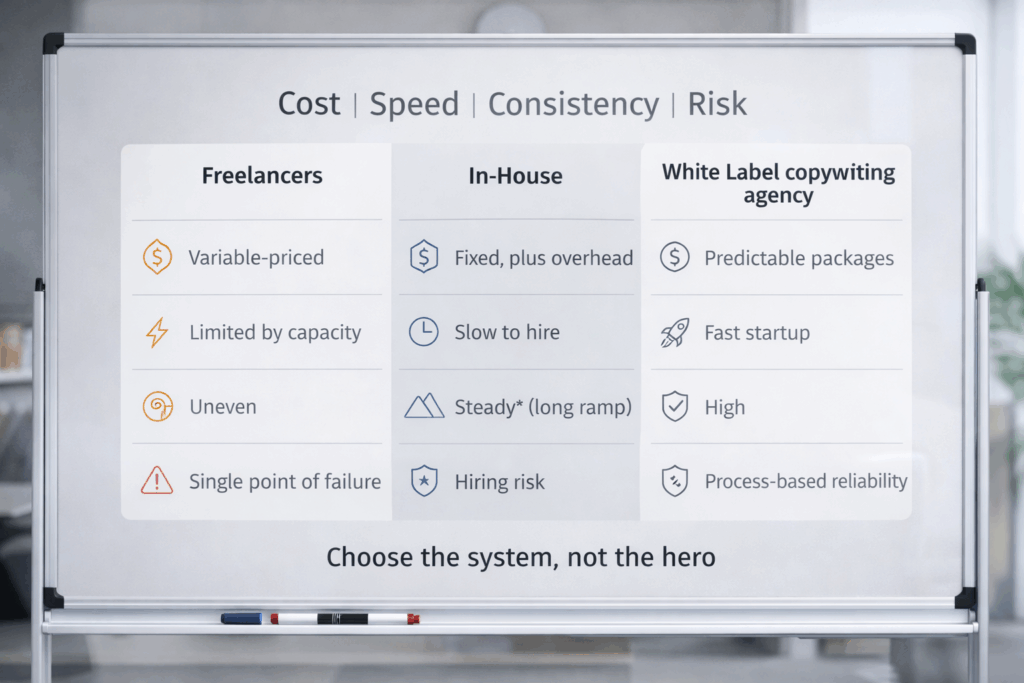
| Option | Cost Profile | Speed to Start | Consistency Over Time | Operational Risk | Best Fit |
|---|---|---|---|---|---|
| Freelancers | Variable, often low upfront | Fast if you already have someone | Medium to low unless managed tightly | Medium to high | One-off projects, flexible needs |
| In-house writers | High fixed cost plus overhead | Slow due to hiring and onboarding | High once the team is mature | Medium | Deep product knowledge, steady volume |
| White label copywriting agency | Predictable packages or retainers | Fast, usually days not months | High because the process is the product | Low to medium | Scaling output without hiring burden |
This is not about one option being “good” and another being “bad.” It is about matching your operating model to your reality. Most growing teams underestimate the management burden of writing, and that is where white label wins.
A strong freelancer can feel like a cheat code. You pay for output, they move quickly, and you avoid payroll.
The problem is not quality. The problem is fragility. One freelancer is one person with one schedule, one inbox, and one set of life events that can disrupt your plan.
Freelancers also vary wildly in how they interpret briefs. If you have ever received a draft that technically answers the topic but completely misses your audience, you know the pain. It is not malicious. It is just misalignment plus limited context.
You can make freelancers work, but you need a real process: briefing standards, examples, editing, and a bench of backup writers. The moment you build that, you have quietly started building what an agency already is.
In-house writing sounds like the cleanest solution. They sit in meetings, they learn the product, and they can become the voice of the brand.
The hidden cost is not salary alone. It is recruitment time, onboarding, management, tools, and the opportunity cost of senior people spending weeks getting a writer up to speed. It is also the reality that most companies do not hire editors first, so the in-house writer becomes both creator and quality control.
In-house also adds fixed cost. When demand dips, payroll does not. When demand spikes, one writer is still one writer, and your “content engine” becomes a queue.
If you are a mature organization with stable volume and clear messaging, in-house can be powerful. If you are still finding product-market clarity, you may end up paying a premium for internal drafts that still require heavy rewrites.
White label agencies win because they turn writing into a repeatable production line.
You are not just getting a writer. You are getting intake, editorial standards, formatting, quality checks, and a delivery cadence that does not depend on one person being “in the zone” this week.
White label also reduces the management load within your team. That matters because the true bottleneck is rarely writing. The bottleneck is the internal back-and-forth, unclear briefs, and constant context switching. A good white label partner pulls clarity out of chaos and hands you a clean deliverable.
There is also a brand protection benefit. White label work is built to match your voice. That means you avoid the “every page sounds like a different company” problem that happens when multiple freelancers come and go.
If you are an agency yourself, white label is often the only way to scale without turning your founder into a project manager. You keep client ownership and margin, while the production engine runs in the background.
Imagine your content operation like a kitchen.
A freelancer is like hiring a great private chef for one night. When they are available, it is amazing. When they are not, dinner does not happen. If you want dinner every night at the same time, you need more than talent; you need a system.
In-house writers are like building a full kitchen staff. You can get incredible results, but you need hiring, training, management, and you are paying even on slow nights. That makes sense when you are serving a steady crowd, not when your demand comes in waves.
White label is like a caterer with a proven menu and logistics. You still decide what to serve and how it should taste, but the execution is predictable. You can scale up for a busy season without rebuilding the kitchen.
Now, picture a product launch.
With freelancers, the risk is coordination. You might get great drafts, but your timelines can slip if your writer disappears, or if you need a second writer to cover a new page, and the voice does not match. You spend your “saved money” on revision cycles and internal stress.
With in-house, the risk is ramp time. You might not even be fully staffed by the time the launch window arrives. Hiring is not a switch you flip, and good writers are not sitting around waiting.
With white label, the risk shifts into vendor selection, which is a better kind of risk. You can evaluate process, samples, and turnaround before committing, then plug the work into your launch plan.
Finally, think about long-term consistency.
Content performance compounds when you publish reliably, interlink logically, and keep tone consistent across the site. That is hard to do with rotating freelancers and an in-house team that is constantly pulled into other priorities.
A white label partner that operates like an editorial team can keep the machine moving even when your internal team is busy. That is the difference between “we should publish more” and “we publish every week.”
Here is the uncomfortable truth: writing is easy to buy, but editing, briefing, and managing writers is the real cost.
If your team has a strong editor and a clean process, freelancers can work well. If your team does not, freelancers can quietly become a time sink.
If your organization is ready to invest in a long-term content function, in-house can be great. If you are still building momentum, in-house can lock you into fixed costs before you have consistent results.
White label wins because it bundles management into the service. That is why it feels “faster” even when the writing time is similar. The workflow is already built.
If your white label partner cannot do these six things, you are not buying a system. You are buying outsourced chaos.
Use freelancers when you have a clear brief, a strong internal editor, and you need specialized expertise for a specific project. Do not use freelancers as your entire production engine unless you are prepared to manage a bench of writers and accept variability.
Use in-house writers when writing is a core competency of the business, volume is steady, and you can support them with editing and clear priorities. Do not hire in-house to solve a short-term backlog, because hiring and onboarding will outlast the original problem.
Use white label when you need consistent output, predictable timelines, and a repeatable process that does not depend on hiring. Do not use white label if you are unwilling to provide basic inputs like audience, offer, and examples of your voice, because no external partner can guess what you refuse to define.
One more practical note: treat this article like a hub page in your internal knowledge base for “how we resource writing,” and revisit it annually or whenever platform standards and buyer behavior shift.
No. Agencies use it heavily, but brands use it too when they need volume without hiring. The defining feature is that the work matches your brand and process, not who the client is.
It will if the intake process is weak. With a solid brief and voice samples, white label can be more consistent than juggling multiple freelancers.
Upfront, often yes. After revisions, missed deadlines, and management time, they can become more expensive than a predictable partner.
When writing volume is stable, the business is mature, and content is strategic enough to justify fixed cost. It works best when writers are supported by strong editing and clear priorities.
Single-point-of-failure risk. If one person gets busy or disappears, your publishing plan collapses unless you have backups.
Hiring the wrong fit or under-supporting them. A great writer without process and editing becomes a bottleneck, and you still pay the fixed cost.
Look for process, not promises. Ask how they handle intake, voice matching, editing, and delivery, then judge them by the clarity of their answers.
A strong partner can. The key is having separate standards for informational pages versus conversion-focused pages, because the job of the page is different.
If you are deciding between white label, freelancers, and in-house, stop arguing about talent and start designing for reliability.
Freelancers can win on flexibility, and in-house can win on deep context. But for most teams that want predictable output, consistent voice, and fewer moving parts, white label is the best balance of cost, speed, consistency, and risk.
If you want help building a content engine that stays affordable and actually ships, Scriba Creative is built for exactly that. Head to scribacreative.com and take the next step that fits your situation, whether that is a quick assessment, a plan, or a scalable production partner.
