Address
304 North Cardinal St.
Dorchester Center, MA 02124
Work Hours
Monday to Friday: 7AM - 7PM
Weekend: 10AM - 5PM
Address
304 North Cardinal St.
Dorchester Center, MA 02124
Work Hours
Monday to Friday: 7AM - 7PM
Weekend: 10AM - 5PM


“Do I still write for Google, or do I write for AI now?” That’s the question behind almost every content panic I’ve heard lately, whether it comes from a SaaS founder, a local service business, or an agency lead trying to protect retainers.
Here’s the quick answer: you write for people first, but you structure for machines. Search engines still send the clicks, and AI systems increasingly shape what people believe before they ever click, so you need content for search that can do both jobs.
You might still rank, yet see fewer clicks because the “answer” shows up before your page does. Or you might get traffic, but never get mentioned in AI summaries because your content is hard to parse, hard to trust, or missing key context.
If you want one mental model: in 2026, your content is not just a page. It’s a reference. The best pages read like a helpful human wrote them, and they behave like a clean data source when a machine needs to quote, summarize, or compare.
Writing content for Search + AI in 2026 means creating content that satisfies a real human question with clear structure, specific evidence, and strong context, while also making it easy for search engines and AI systems to extract, trust, and reuse accurate takeaways.
Most people treat this like a formatting trick. They add a few extra headings, toss in a definition, and hope they get picked up in AI answers. That’s not the core of it.
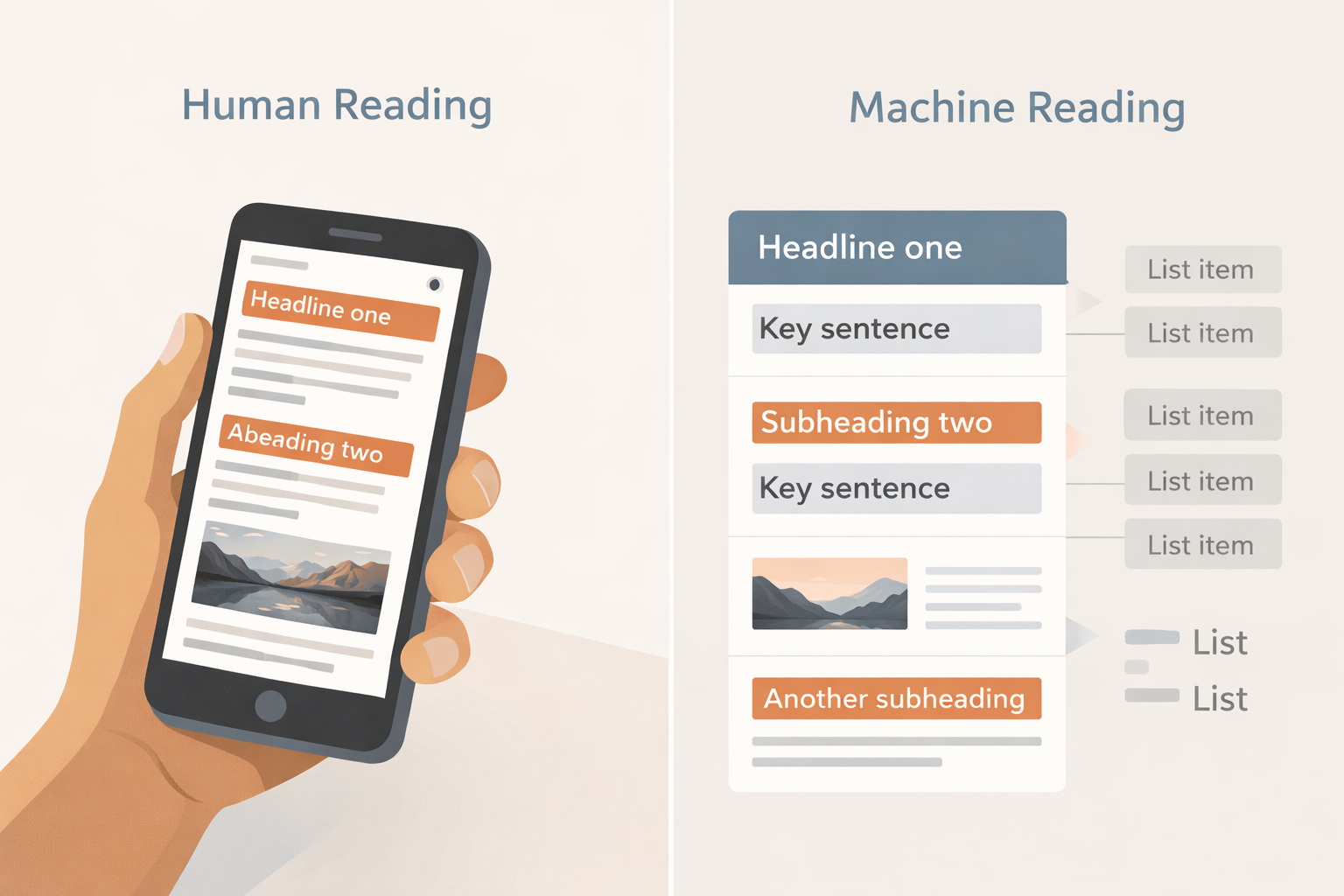
The real shift is that your content needs to work in two modes at the same time. Mode one is the human mode: someone lands on your page, scans it, and decides whether you understand their problem. Mode two is the machine mode: a system reads your page, decides whether you are trustworthy, and decides whether your text is “clean enough” to reuse without causing embarrassment.
This is why vague content is dying faster than ever. If your writing is generic, it blends in on the search results page. If your writing is generic, it also gives an AI system no reason to prefer you over ten other sources that said the same thing.
So the goal is not “optimize for AI.” The goal is to become the most usable source on the topic. That usually means clarity, completeness, and proof, not clever phrasing.
If you run a business, content is supposed to be an asset that compounds. You publish today, and it brings leads for months. But when the discovery layer shifts, compounding can turn into leaking.
The first tradeoff is time. Writing for both takes more intent up front, because you cannot rely on thin posts that only chase a phrase. You have to pick a real question, define your stance, and cover the decision points a buyer actually cares about.
The second tradeoff is that “ranking” is no longer the same as “winning.” You can rank and still lose the click to an on-page answer. You can also get mentioned by AI and still fail to convert because your page does not build trust once someone lands.
The second-order effect is brand perception. If AI summaries become a first impression, then your clarity, accuracy, and specificity are no longer just content quality. They are your reputation. This is why I tell teams to treat these pages like product surfaces, not like blog posts you publish and forget.
Also, this is a good hub topic for your internal knowledge base. If you’re building your internal knowledge base, this should be your hub page for “writing for search and AI,” with your supporting guides branching off of it. Update it annually or whenever major search presentation standards change.

To write well for both, you need to accept a slightly uncomfortable truth. People want answers fast, and they want to trust them without doing homework. Search results pages and AI experiences are both trying to reduce the friction between a question and an answer.
That doesn’t mean your website is irrelevant. It means your website needs to earn the role of “source,” not just “destination.” Some visitors will still click because they want details, pricing, comparisons, examples, steps, or reassurance. But the quick summary moment is happening earlier, and you need to show up there too.
Here’s a simple way to think about it: search is still the library catalog, and AI is increasingly the librarian. Your job is to write the book in a way that makes the librarian comfortable recommending it.
| Content Goal | What The Reader Wants | What The Machine Needs | What Your Page Must Do |
|---|---|---|---|
| Rank in classic search results | The best page for the query | Clear topic signals and relevance | Match intent, cover the topic, be easy to scan |
| Be used in AI summaries | A confident, accurate answer | Extractable claims with context | Tight definitions, specific details, low ambiguity |
| Convert after the click | Proof and a next step | Consistency across page elements | Clear offer, trust signals, and an obvious path forward |
Think of your content for search like a sales call recording. When a human listens, they want tone, empathy, and a clear recommendation. When a machine listens, it wants clean audio, clear speakers, and crisp statements it can quote without guessing. Great content has both: it’s human in intent and structured in delivery.
Example one: a pricing explanation page. In the old world, teams avoided specifics because they feared scaring people off. In the 2026 world, vague pricing pages fail twice. Humans bounce because they feel manipulated, and machines avoid quoting you because you did not say anything concrete.
Example two: a “what is X” explainer for a complex service, like technical audits or compliance. A human needs an analogy and a plain-language definition. A machine needs consistent terminology, clear sectioning, and fewer slippery statements like “it depends” without boundaries. The winning page gives the analogy, then gives the boundaries, then gives a simple decision rule.
Example three: a local service business page, like a clinic or contractor. The classic mistake is writing a page that reads like a brochure. It says you are “trusted” and “experienced,” but it never explains what the process looks like, what problems you solve, or what outcomes people can expect. A machine cannot turn that into a reliable answer, and a person cannot use it to choose you over someone else.
One more analogy I love: writing for both is like designing packaging for retail and shipping. Retail packaging must look good and persuade a shopper in three seconds. Shipping packaging must protect the product and be labeled clearly so it arrives without issues. If you only do one, you lose.
A direct answer early on that states the takeaway in plain language, without throat-clearing, so both scanners and machines can grab the point fast.
A tight definition section that uses consistent wording and avoids fuzzy terms, because definitions are the easiest units for machines to reuse accurately.
Clear intent alignment where the page type matches the query, so an informational question is not forced into a sales pitch, and a buying question is not buried under a long lecture.
Specific evidence and context like examples, constraints, and “here’s when this is true,” which makes your claims safer to quote and more convincing to humans.
Clean structure and scannability with descriptive headings and short paragraphs, because both humans and machines struggle with walls of text.
A trust layer that shows who wrote it, what experience informs it, and how you keep it accurate, so you look like a source worth referencing, not a content farm.
You need to write more clearly, not more robotically. The same page can serve both if it answers the question directly, stays consistent, and avoids vague claims. Think “easy to quote” and “hard to misunderstand.”
No, but it will reshape where clicks happen. People still click when they need depth, reassurance, comparisons, or to take action. Your job is to make your site the best next stop after the quick answer.
Content that states the answer cleanly and supports it with context. Definitions, step-by-step explanations in paragraph form, comparisons, and decision rules tend to travel well. Content that is fluffy or promotional tends to get ignored.
Yes, most intros should get shorter. Lead with the answer or the decision point, then expand. If someone has to scroll to find your point, both people and machines lose patience.
It matters when it is specific and earned. Strong opinions backed by clear reasoning can differentiate you in search results and in AI summaries. Empty hot takes do nothing.
Only if it improves clarity. Structure is a tool to make meaning easier to extract and scan. If extra sections add noise, they hurt you.
Be specific about what you mean, show boundaries, and avoid sweeping promises. Explain the process, the tradeoffs, and what “good” looks like. Trust is built through precision.
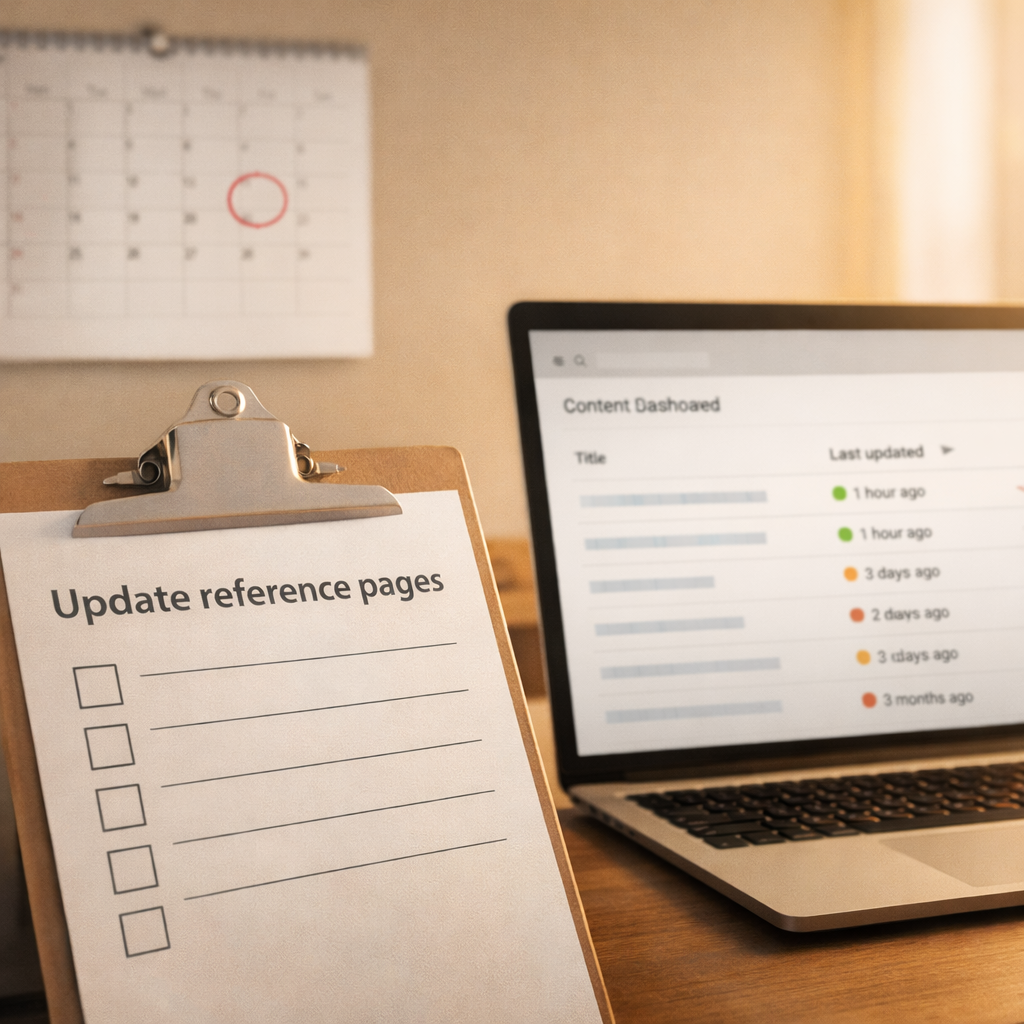
Update your best “reference” pages first. Those pages have the highest chance of being reused, summarized, and linked internally. New posts are great, but refreshed foundations usually win faster.
Yes, when the question requires depth to answer honestly. Longer content gives you room to define terms, handle edge cases, and include examples that reduce confusion. Length only helps if the page stays tight and useful.
If you want your content for search to work in 2026, stop thinking about pages as “blog content” and start thinking about them as tools. A great page answers the question, earns trust, and gives the reader a next step. A great page also gives machines clean statements they can reuse without guessing.
At Scriba Creative, this is the lens we use: topic first, proof second, structure always. If you want help turning your highest-value topics into source-quality pages that can rank and show up in AI answers, take the next step and use us as your content production partner so you can stop guessing and start publishing with intent.
