

The Hard Question Everyone Asks: “How Often Should We Publish, Really?”


If you run a small team, you have asked this question in some form: What blogging frequency is actually realistic in 2026 without burning out or publishing fluff? You are not asking because you lack ambition. You are asking because you have lived the reality of Slack pings, client work, product deadlines, and the “we should really post more” guilt loop.
Here’s the blunt answer: most small teams can sustainably publish one strong post per week or one strong post every two weeks, and still win. You do not need to publish daily. You do not need to chase volume like it is 2016. You need consistency, relevance, and a system that survives a busy month.
If you are trying to decide whether to hire a blog writing service or a blog writing agency, this post will help you choose a frequency that matches your team’s capacity and your business goals, not an imaginary ideal.
A Simple Definition You Can Use Internally
Blogging frequency is the repeatable pace at which your team can publish helpful, search-driven posts that match your customers’ questions, maintain quality, and support business goals, without relying on heroics or last-minute scrambling.

What Blogging Frequency Looks Like in 2026 (And Why It Changed)
In 2026, blogging frequency is not just a calendar decision. It is a workflow decision, a quality decision, and a distribution decision. Search behavior is messier now because people bounce between classic search, AI summaries, and social recommendations, but the underlying reality is stable: buyers still look for clear answers and proof you understand their problem.
Small teams usually overestimate how much they can produce, then underestimate how long it takes to produce something worth reading. A “simple” blog post rarely stays simple. You need a real topic, a point of view, examples, a clean structure, images, and a pass for clarity. Then you still have to publish it and share it.
The biggest shift I see is this: frequency without a system collapses fast. You can publish four posts in a month on adrenaline. You cannot do that for a year unless your process is boring, repeatable, and protected from chaos.
That is why the best content programs I see in 2026 look less like a sprint and more like a subscription. They show up on a predictable rhythm. They build a library that answers the same questions sales calls are already fielding. They treat each post like an asset, not a checkbox.
If you are building your internal knowledge base, this should be your hub page for blogging frequency decisions, because everything else flows from it: your editorial calendar, your content budget, your internal reviews, and your decision to outsource to a blog writing agency or keep it in-house.
Why Blogging Frequency Matters More Than People Admit
Frequency is not a vanity metric, but it has real second-order effects. When you publish consistently, you get faster feedback on what resonates. Your team learns what prospects actually care about. Your site becomes easier to navigate because you can build clusters of related topics instead of random posts that never connect.
The tradeoff is straightforward. Higher frequency can increase surface area, but it often lowers quality and raises review friction. Lower frequency protects quality, but it can slow learning and make your site feel stagnant if you do not plan strategically.
There is also an operational cost that people ignore. Every post creates downstream work: internal linking, refreshing older posts, updating claims, and keeping examples current. Content is not “done” when it is published. One sentence should live in your process docs: plan to revisit and update this content annually, or sooner when standards and buyer expectations change.
If you want frequency that helps revenue, it has to be tied to a realistic production model. That is where a blog writing service can be a leverage play. Not because you cannot write, but because your time is better spent making decisions only you can make.
A Realistic Cadence Framework for Small Teams
Before you pick a number, start with one question: What will still be true when things get busy? Because things will get busy. The only cadence that matters is the one you can keep during launch weeks, hiring gaps, and client crunch.
Here is a simple way to think about it: publishing pace depends on three constraints, not one. Constraint one is writing time. Constraint two is review time. Constraint three is publishing and distribution time. Most teams only plan for constraint one, then wonder why the calendar falls apart.
Blogging Frequency Reality Check Table

| Team Situation | Realistic Sustainable Frequency | What Usually Breaks First | What To Fix |
|---|---|---|---|
| Solo founder doing everything | 2 posts per month | Publishing consistency | Reduce scope and create templates |
| 2 to 3 person team with mixed roles | 2 to 4 posts per month | Review bottlenecks | Set a 48-hour review rule |
| Small marketing team, no dedicated writer | 1 post per week | Writing time | Outsource drafting to a blog writing service |
| Marketing team with clear ownership | 1 to 2 posts per week | Topic selection | Build a question-driven backlog |
| Agency team managing multiple clients | Per client: 1 to 2 posts per month | Coordination | Standardize briefs and approvals |
This is not a rulebook. It is a sanity check. If your current plan is double what this table suggests, your team is probably relying on best-case weeks.
Real Examples and Analogies That Make This Click
Think of blogging frequency like going to the gym. If you design a plan you can only do when life is perfect, you will quit. A sustainable routine beats a heroic routine every time, because you are trying to build a habit, not win a single week.
Now think of your blog like a retail store. Publishing is putting new products on shelves. If you stock the store with rushed products, customers stop trusting the shelf. If you only add one great product every month, but it is exactly what customers want, you become a destination. The store grows by being dependable, not by being loud.
The Top 6 Must-Have Features of a Blogging System That Does Not Collapse
- A question-driven backlog. Every topic should map to a real customer question, not a brainstorming session that felt fun on Monday.
- A repeatable brief format. If every post starts from scratch, your team will stall. A good brief includes audience, intent, angle, and examples to include.
- Clear ownership and deadlines. Someone owns the draft, someone owns the review, and the publish date is not a suggestion.
- A quality bar that is visible. Define what “good” means with structure, clarity, and concrete examples so the team does not argue in circles.
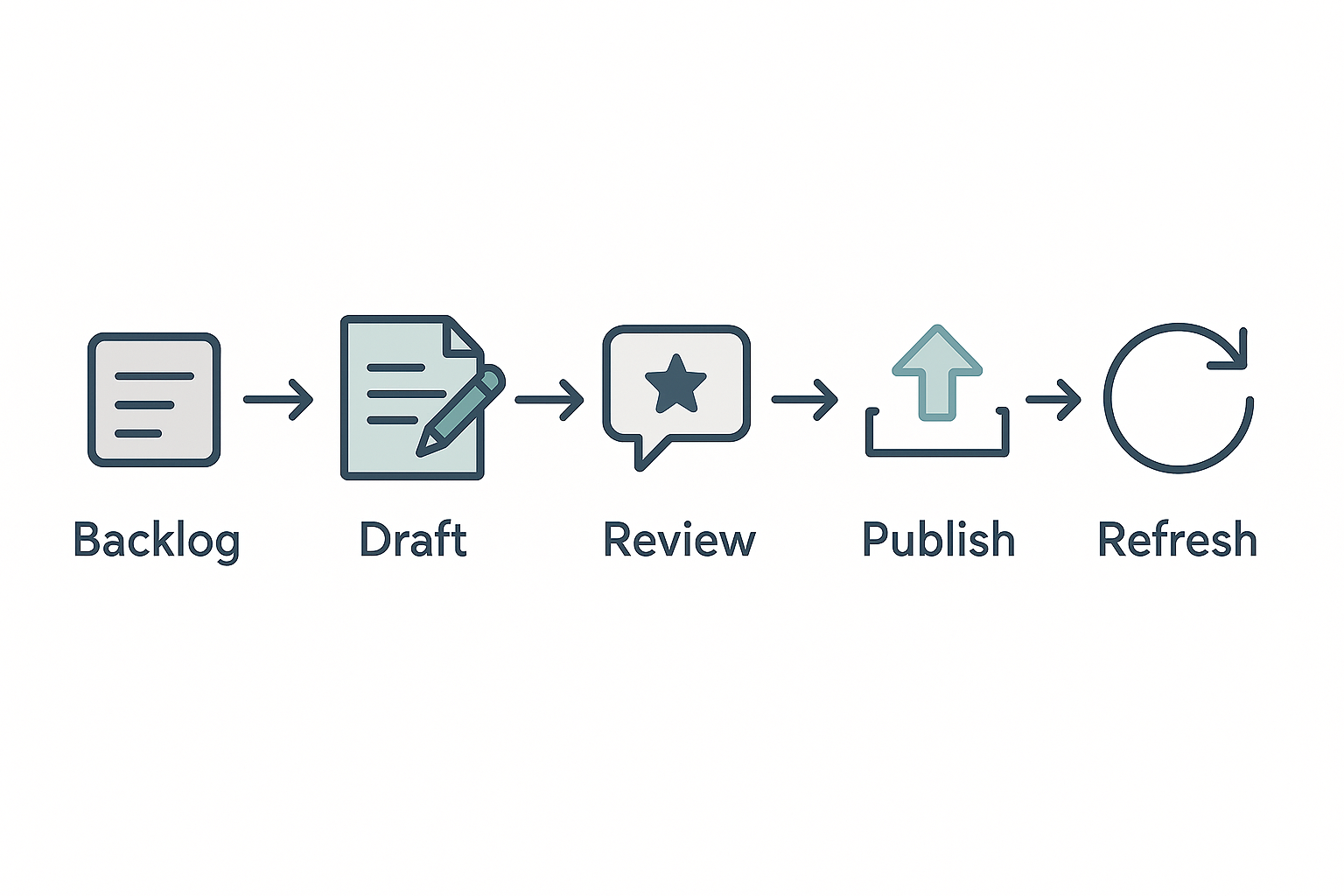
- A workflow for publishing and refreshing. Publishing is a step, not the finish line. Refresh old posts and improve internal links as the library grows.
- A leverage option when capacity dips. This is where a blog writing service or blog writing agency keeps your cadence alive when your team is focused elsewhere.
When to Publish More (And When to Publish Less)
If you are early-stage and still learning who your buyer is, you may benefit from slightly higher frequency for a short season. Not because volume itself wins, but because publishing forces clarity. You will learn faster which questions actually drive qualified calls.
If you are in a competitive category where buyers compare vendors aggressively, consistency matters more than speed. A steady cadence builds a body of proof that you understand the space. That is often better than a burst of content followed by silence.
Publish more when you have a backlog of clear, high-intent topics and a workflow that does not rely on one person’s motivation. Publish less when your posts are getting vague, your reviews are dragging, and your team is writing to fill a slot instead of to answer something important.
The fastest way to waste content is to publish too often with too little to say. The second fastest way is to publish too rarely and never build momentum. Your goal is the middle path: a rhythm that protects quality and compounds.
How a Blog Writing Service or Blog Writing Agency Changes the Math
Outsourcing is not a magic button. It is a trade. You trade money for time, and you trade internal effort for external process. The win happens when your team stops treating content as a scramble and starts treating it as a system.
A blog writing service can make sense when you already know what to publish, but you cannot get drafts produced consistently. You bring the topics, the expertise, and the review, and you outsource the heavy lifting of turning that into publish-ready writing.
A blog writing agency can make sense when you want more than drafting. You want help shaping the calendar, choosing topics, building internal linking logic, and maintaining a consistent voice across a growing library. The right agency does not just write. They reduce decision fatigue.
Here is the founder-level truth: the biggest cost in content is not writing. It is context switching. If your best people are constantly dropping into “write a post real quick,” you are paying for content with focus, not with hours. A good partner protects that focus.
FAQ: The Questions People Keep Getting Wrong
How many blog posts per month is “good” in 2026?
For most small teams, two to four strong posts per month is both realistic and effective. Consistency and clarity beat volume. If you cannot maintain quality, reduce frequency.
Is one blog post per week enough to grow?
It can be, especially if the posts target high-intent questions and connect to your services. Growth comes from relevance and compounding, not just publishing speed. One per week done well is a strong cadence.
Does publishing daily help anymore?
Daily publishing can work for media brands with dedicated editorial teams. For small teams, it usually creates thin content and burnout. Most businesses do better with fewer posts that actually answer buyer questions.
What if we can only publish once a month?
Once a month can still work if the post is substantial and strategic. Pair it with updates to older posts so your site stays fresh. You can also outsource drafts through a blog writing service to increase cadence without adding headcount.
How long should blog posts be now?
Length should match the question, not a word count target. Many competitive topics need deeper explanations and examples to be useful. If the reader feels taken care of, you picked the right length.
Do we need to write for AI answers differently?
Write for humans first, but structure matters. Clear headings, tight definitions, and concrete examples help your content get summarized correctly. Avoid vague filler because it fails both people and machines.
Should founders write the posts themselves?
Founders should supply the point of view and the examples, not necessarily the entire draft. Your insight is the scarce ingredient. A blog writing agency can turn that insight into consistent publishing without stealing your calendar.
How do we keep blog quality high with a small team?
Set a clear quality bar and reduce friction in the process. Use templates, keep reviews fast, and build a backlog from real customer questions. If writing time is the bottleneck, outsource drafts and keep internal review.
Final Thoughts

If you want a realistic blogging frequency in 2026, stop asking “what should we do” and start asking “what will we still do in a chaotic month.” That answer is your baseline. Build your editorial calendar around that baseline, then scale up only when the system proves it can hold.
If you are trying to grow with content but your team is stretched, this is exactly where a blog writing service or a blog writing agency earns its keep. You keep the strategy and the expertise. A partner keeps the cadence alive and turns your knowledge into a library that compounds.
If you want help choosing a sustainable cadence, tightening your content workflow, or getting publish-ready posts without adding headcount, take a look at what we do at scribacreative.com. The next step is simple: book a call or request an assessment so you can leave with a frequency plan your team can actually execute.